
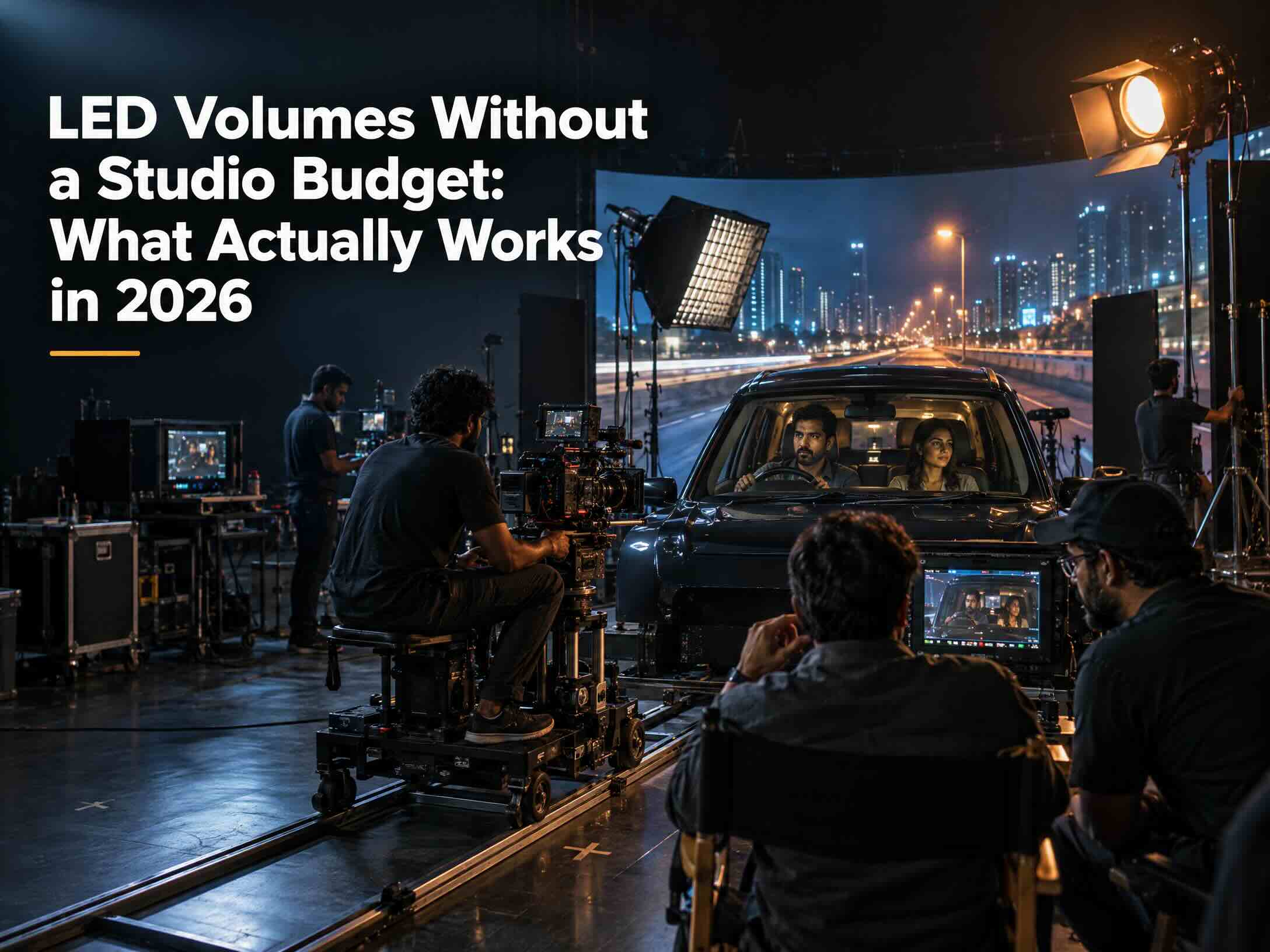
A few years ago, LED volumes were something you saw in behind-the-scenes clips from very large shows: a wall the size of a building, a ceiling of panels, a long desk of engineers in black T-shirts. It looked expensive because it was.
That picture has changed. Rental stages with smaller walls have opened in Mumbai, Hyderabad, Chennai, and most major production cities abroad. Industry reporting through 2025 and 2026 describes LED stages turning up on ad films, music videos, OTT series, and mid-budget features, not only on tentpoles.
But a cheaper wall does not mean a cheaper film. I have seen productions save two days with a volume, and I have seen productions lose a day because they booked one for the wrong scene. The wall is a tool for specific shots, not a replacement for a location. This piece is about telling the difference before you sign the stage contract.
The Words You Will Hear on a Volume
Stage teams use a lot of shorthand. If you are a producer or a first-time director on a volume, these are the terms that will come up in the first meeting.
- LED volume
- A stage where large LED panels display a background in real time, so the camera records the actor and the “world” together in one shot.
- Micro-volume
- A smaller version of the same idea. Usually a flat or gently curved wall a few metres to about ten metres wide, often with no LED ceiling.
- Pixel pitch
- The distance between the centres of neighbouring LEDs on a panel, measured in millimetres. Smaller pitch means you can get the camera closer before the grid shows.
- Frustum
- The area of the wall that matches what the lens sees. On a tracked 3D shoot, this patch renders at full quality and moves with the camera.
- Brain bar
- The desk of operators who run the content, tracking, and wall hardware. On small shoots it may be two people.
- Plates
- Filmed background footage, usually shot with several cameras, played back on the wall. Cheaper than 3D, but with limited camera movement.
- Genlock
- A shared timing signal that keeps the camera, the LED processors, and the render machines in step, so you do not get flicker or tearing.
You do not need to master all of this. You need to know enough to ask the right question when someone says “we can fix that on the wall”.
What a Micro-Volume Really Gives You
When most indie producers say “LED stage”, they mean a micro-volume, sometimes with a couple of movable panels on rolling frames for reflections and fill1.
What you get:
- A real background in camera, so actors can see the world they are in.
- Real interactive light from the wall on faces, wardrobe, chrome, and glass.
- Repeatable time of day. Golden hour lasts as long as you need it.
- A finished-looking frame on the monitor, which helps the director, the client, and the actors make decisions on the day.
What you do not get:
- Wide shots. A small wall covers a small slice of frame. Plan for mids and close-ups, or plan to extend the set in post.
- Free movement. Big camera moves expose the edges of the wall and break the illusion.
- A full lighting package from the screen. The wall is a soft, fairly dim source. It is not your key light.
If your shot list is built on wide masters and sweeping crane moves, a micro-volume is not the tool. If it is built on coverage inside a car, through a window, or on a tight street corner, it might be exactly right.
Note
Stage sizes, panel specs, and rates vary a great deal between facilities, even within one city. Treat any number a stage gives you over the phone as a starting point and ask for the full spec sheet in writing.
Location or Volume: A Quick Way to Decide
Before anyone talks about Unreal Engine, run each scene through a simple test. I sketch something like this with the director and first AD during the early schedule.
flowchart TD
  A["Scene on the shot list"] --> B{"Mostly mids and close-ups?"}
  B -- No --> L["Shoot on location or a built set"]
  B -- Yes --> C{"Is the real location slow, risky, or costly?"}
  C -- No --> L
  C -- Yes --> D{"Can we lock angles and content a week ahead?"}
  D -- No --> L
  D -- Yes --> E{"Heavy rain, fire, dust, or debris near the wall?"}
  E -- Yes --> H["Hybrid: practical effects on a set, wall only for backgrounds"]
  E -- No --> V["Price the volume seriously"]
The point of the chart is not to reach a perfect answer. It is to stop the conversation from starting with “virtual production is the future, let’s use it”. Start with the scene, not the technology.
Where LED Pays for Itself
These are the scenes where I would seriously price a volume against location.
Car work
This is the best use for small productions. A car on a stage with driving plates on the wall gives you real reflections on the glass and bodywork, actors focused on performance instead of traffic, and no road permits or low-loader rigs. A full conversation scene from six angles moves much faster than on a process trailer on Indian roads, and your sound team will thank you.
Controlled night exteriors
A night street with rain, neon, and traffic is slow and costly on location. It burns crew, invites trouble with permissions and crowds, and pushes everyone into overtime. A stage can give you a convincing version of the same scene in day hours.
Weather and season
Monsoon scenes in December, a winter evening in a Mumbai summer, a sunset that holds for three hours. A volume does not care about the forecast.
Window backgrounds
Office towers, train windows, aircraft cabins, high-rise flats. A small wall behind a practical window set is one of the most cost-effective setups you can do, because the window frame hides the edges of the wall for you.
Locations you cannot take a unit to
A heritage site with tight rules, a foreign city, a border town. A small plate unit can capture backgrounds for far less than moving the full crew.
Where the Location Still Wins
Be honest about this list, because the stage salesperson will not be.
| Situation | Volume | Location or built set |
|---|---|---|
| Car interiors, dialogue | Strong fit | Slow, noisy, permit heavy |
| Window and cabin backgrounds | Strong fit | Fine, but light changes all day |
| Wide, deep exteriors and crowds | Weak, wall too small | Strong fit |
| Fire, water, dust, debris | Risky for panels | Strong fit |
| Actors walking through space | Limited depth | Strong fit |
| Hard daylight sun | Needs big lighting package | Free, if the weather holds |
| Scenes still being discovered | Punishes changes | Rewards exploring |
The last row matters more than the others. A volume rewards planning and punishes improvisation. If the director is still finding the scene on the day, go to location.
Warning
Many stages restrict water, smoke, haze density, and pyrotechnics near the panels, or charge for protective covers and cleaning. Ask about this before you write the rain scene into the stage schedule, not after.
Previs Is Not Optional
On location, you can walk around and find the shot. On a volume, the shot has to exist before you arrive, because the background content needs to be built, captured, or licensed in advance2.
At minimum, before the shoot day:
- Lock the angles. Know your lens, camera height, and rough framing for every setup. This tells the content team how much of the background has to hold up.
- Decide 2D plates or 3D environments. Plates are cheaper and look real, but camera movement is limited. 3D environments in Unreal Engine allow parallax and movement but take time and skill to make convincing. Many indie shoots mix both.
- Run a tech scout on the stage. Bring the DP, gaffer, and the content operator. Put a stand-in in front of the wall and shoot test frames with your actual camera and lens.
- Approve the content early. Changes on the day are slow. A new sky can take minutes or hours depending on how the scene is built.
| 2D plates | 3D environment | |
|---|---|---|
| Look | Real footage, very convincing | Depends on artist skill and time |
| Camera movement | Small moves, mostly locked off | Parallax, dolly, crane within limits |
| Prep cost | Plate shoot days | Build and optimisation weeks |
| Changes on the day | Swap clip, adjust colour | Move objects, relight, change sky |
| Tracking needed | Usually no | Yes |
Tip
Budget a prep day on the stage before principal days. It is usually cheaper than losing half a shoot day to colour matching and moiré fixes.
How a Volume Shoot Day Actually Runs
People imagine the wall just “plays”. In practice, each setup is a short loop of requests between departments. This is roughly how a good day sounds on a small stage.
sequenceDiagram
  participant AD as First AD
  participant BB as Brain bar
  participant DP as DP and gaffer
  participant CAM as Camera team
  AD->>BB: Next setup, scene 42, close on driver
  BB->>BB: Load plate, set time of day
  BB-->>DP: Background is up
  DP->>BB: Warm the sky, drop wall brightness a touch
  DP->>CAM: Lens, stop, and focus distance
  CAM->>BB: Check sync and shutter for flicker
  BB-->>CAM: Sync confirmed
  CAM-->>AD: Ready to roll
  AD->>AD: Rehearse, then shoot
Notice that the brain bar talks to almost everyone. If the operators are left out of the shot list, every setup slows down.
Lighting Is Still Physical
New producers sometimes assume the wall lights the scene. It does not. It gives you ambient colour and reflections. Your gaffer still needs real units to shape faces, create hard light like sun or street lamps, and add contrast. Most good volume setups use:
- Traditional fixtures for key and edge light.
- Movable LED panels or tiles for reflections off cars and glass.
- Pixel-mapped or DMX-controlled lights synced to the content, so a passing streetlight on the wall also passes across the actor’s face.
That last point is where VP starts to look real. Budget the lighting department as if you were on a normal stage, then add the sync work on top.
Important
The light from an LED wall is not a full-spectrum source like a good film fixture3. Skin tones can shift in ways that are hard to fix in the grade. Test your actors’ skin under the wall during the tech scout and let your colourist see the test footage.
Pixel Pitch, Moiré, and Other Technical Traps
A few technical issues catch productions every time.
Pixel pitch
Smaller pitch means you can put the camera closer to the wall and focus nearer to it without seeing the grid. Cheaper stages often have larger pitch panels. Ask for the exact spec and test it with your lens. As a rough habit on set, the bigger the pitch, the more distance you want between your talent and the wall.
Moiré
When the camera sensor and the LED grid interfere, you get rippling patterns. It gets worse when the wall is in sharp focus. Keep the wall soft (distance and aperture both help), avoid focusing near it, and test before the shoot day.
Refresh and shutter sync
Mismatched settings cause flicker or banding, especially at high frame rates or with odd shutter angles. Your camera team and the stage engineer need to agree on settings in advance and write them down.
Colour and brightness drift
Panels from different batches can look slightly different, and walls can shift as they warm up. A good stage calibrates regularly. Ask when it was last done.
Caution
Do not “fix moiré in post” as a plan. Removing it frame by frame is slow and expensive, and on some shots it cannot be fully removed. If you see it on the monitor, stop and change distance, focus, or lens before you roll.
The Brain Bar Is a Real Crew Role
On small shoots the brain bar might be one or two people. Treat them as department heads, not as vendors.
Roles you will usually need:
- Unreal Engine or playback operator. Runs the content, adjusts skies, moves elements, matches colour on request.
- Tracking technician. Manages the camera tracking system if you are using 3D environments.
- LED or stage engineer. Handles panels, processors, and sync.
- VP supervisor. Connects the director and DP to the technical team. On smaller jobs, this role often merges with the operator4.
Put them on the call sheet, bring them to prep meetings, and give them the shot list early. A good operator who understands the scene saves more time than any hardware upgrade.
Budgeting Without Fooling Yourself
The stage day rate is only one line. When I compare a volume against location, I put these next to each other:
- Stage rental, including prep and wrap days.
- Content: plate shoot, 3D builds, or licensed environments.
- Brain bar crew, often charged separately from the stage.
- Lighting package and the sync work.
- What you save: travel, permits, unit moves, police, night premiums, weather days, and in many cases a process trailer.
It is common for the volume to cost more per day and less per scene. Compare scenes completed, not day rates. If the stage lets you finish three days of car work in one and a half, that is the real number.
There is also the idea that everything can be fixed on the wall the old habit of leaving decisions until post. A volume moves those decisions into prep. That costs time early, but it usually saves money later.
A Checklist Before You Book a Stage
Run through this with your director, DP, and line producer. If you tick most of it, the volume is worth pricing seriously.
- The scenes are mostly mids and close-ups, with limited camera movement.
- The real location is expensive, risky, slow, or impossible to reach.
- We can lock angles and approve content at least a week before the shoot.
- We have decided plates or 3D for each setup.
- We have tested our exact camera and lens on this exact wall.
- Skin tones have been checked under the wall and shown to the colourist.
- Lighting is budgeted as a full department, not an afterthought.
- The content operator has worked on narrative shoots, not only events.
- Effects rules (rain, haze, smoke) are confirmed in writing with the stage.
- A prep day is in the schedule.
If you cannot tick at least six, a good location and a strong lighting team will likely serve the film better. That is not a failure. It is the right call for that film.
Need a partner who understands budgets, schedules, and delivery across theatrical and OTT? Contact Halawi Media today and let Austin Shivaji Kumar help plan and deliver your next production.
Footnotes
-
These movable panels are sometimes called “wild walls” or simply tiles on a stand. They are often the most useful part of a small stage, because they put reflections exactly where the car or glass needs them. ↩
-
Licensed environment packs exist, but they are used by many productions. If your audience might recognise a stock city, plan to modify it or shoot your own plates. ↩
-
Most LED walls build colour from red, green, and blue emitters only, while good film fixtures aim for a fuller spectrum. That is why a face under wall light alone can look slightly off even when the background looks perfect. ↩
-
On very small jobs I have seen the DIT take on a share of the colour matching between camera and wall. It can work, but only if that person is briefed on the stage setup in prep. ↩